


What Small Developers Need to Know
Biodiversity Net Gain has been one of the more significant changes to the English planning system in recent years.
The principle behind it is relatively straightforward: where development affects habitat, the planning system should not simply accept that loss. In developments subject to mandatory Biodiversity Net Gain (BNG), the objective is generally to leave biodiversity in a measurably better state than it was beforehand, with a minimum 10% biodiversity net gain.
Few would argue with the underlying ambition.
The difficulty has always been how that principle is applied proportionately — particularly to very small development sites.
On 6 August 2026, an important change came into effect.
Planning applications for developments with a site area of 0.2 hectares or less are now exempt from mandatory Biodiversity Net Gain, provided the development does not negatively impact priority habitat.
For small developers and landowners, that could be a significant change.
How did we get here?
Mandatory Biodiversity Net Gain came into effect for most major developments in England on 12 February 2024, before being extended to small developments on 2 April 2024.
For developments within the regime, the general requirement is to deliver at least a 10% increase in biodiversity value compared with the site’s pre-development position.
This is calculated using the government’s statutory biodiversity metric.
That sounds relatively straightforward on paper. In practice, however, establishing the biodiversity value of a site can introduce additional surveys, specialist input, calculations, design considerations and potentially off-site biodiversity measures.
For a substantial development, those requirements may represent a relatively small part of the overall professional costs of bringing a project forward.
For a very small development, they can be disproportionately significant.
The Government itself has recognised this issue. In supporting material accompanying the latest changes, it described the BNG process as potentially being “comparatively burdensome and costly” for the smallest developments.
The new 0.2-hectare exemption is therefore fundamentally about proportionality.
What changed on 6 August 2026?
For planning applications made from 6 August 2026, developments where the site within the red-line planning application boundary measures 0.2 hectares or less are exempt from mandatory BNG.
There is, however, a very important qualification.
If the proposed development negatively affects priority habitat on the site, the exemption does not apply and the mandatory BNG requirements must still be met.
That distinction matters.
The change should therefore not be interpreted as saying that ecology is irrelevant on sites below 0.2 hectares. It means that the statutory 10% BNG regime will no longer automatically be imposed simply because a development requiring planning permission is proposed on a very small site.
Those are two quite different things.
Why does the change matter?
The practical issue with BNG on small sites has never simply been the principle of improving biodiversity.
It is the amount of process that can accompany it.
Where mandatory BNG applies, the existing habitat needs to be understood and its biodiversity value established. The statutory biodiversity metric can then be used to calculate the site’s baseline value and assess what needs to be retained, enhanced or created to achieve the required gain.
Depending upon the site and the habitats involved, professional ecological input may be necessary.
If sufficient biodiversity gain cannot be delivered on the development site itself, a developer may also have to consider off-site biodiversity units or, as a last resort, statutory biodiversity credits.
For larger developments, that process can reasonably form part of a much broader planning and design exercise.
But imagine applying a similar administrative structure to a tiny development site.
The cost and complexity of demonstrating compliance can begin to become significant compared with the scale and value of the project itself.
That is where I believe the new exemption makes sense.
A problem I have seen first-hand
I have recently been involved with a small development where the question of the site’s ecological baseline became a major planning issue.
The site had already been cleared before an adequate ecological baseline had been established.
That created a fundamental problem.
How do you accurately demonstrate the biodiversity value of a site before development when the habitat that previously existed has already been removed?
Assumptions then have to be made about the site’s previous condition and biodiversity value. What might initially appear to be a relatively minor procedural issue can consequently become a significant planning obstacle.
In this particular case, the absence of satisfactory baseline ecological information became an important issue during the planning process and subsequently at appeal.
The experience reinforced something that I think remains important even after the August 2026 changes:
exemption from mandatory BNG does not mean developers should ignore ecology.
It means the response can hopefully become more proportionate to the site and the actual ecological risk involved.
BNG and ecological surveys are not the same thing
This is an important distinction for homeowners, landowners and small developers.
Being exempt from mandatory Biodiversity Net Gain does not provide an exemption from every other ecological consideration within the planning system or from separate wildlife legislation.
A small site can still contain something ecologically important.
Protected species, nesting birds, bats, important trees, hedgerows and priority habitats do not cease to exist because a site happens to measure 0.19 hectares.
Similarly, other planning policies and legal protections may still apply.
This is also why ecological investigations should be proportionate to the actual characteristics of the site.
A previously developed plot with little meaningful habitat presents a very different ecological proposition from a small parcel of established woodland, species-rich grassland or a site containing obvious potential for protected species.
Good planning and good design require us to recognise that difference.
What about extensions and loft conversions?
There is another distinction worth making because BNG terminology can easily cause confusion.
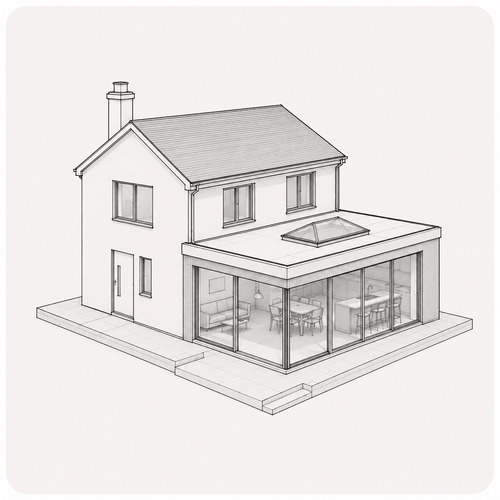
Householder planning applications are already exempt from mandatory Biodiversity Net Gain. Government guidance specifically identifies projects such as home extensions, conservatories and loft conversions within this category.
Permitted development is also outside the mandatory BNG regime.
That does not, however, remove other ecological responsibilities.
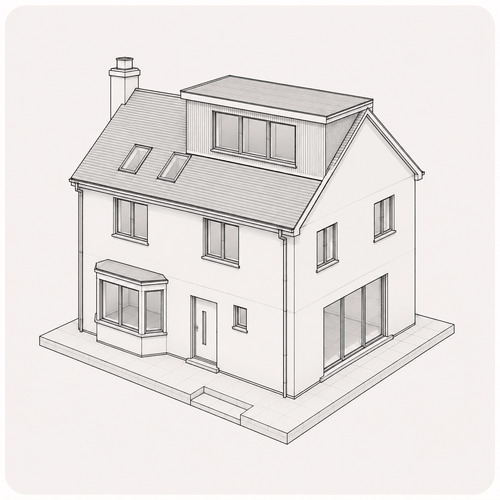
A loft conversion is a useful example.
The development itself may not be subject to mandatory BNG, but if bats are present within the roof, separate wildlife protections may become highly relevant. The fact that work benefits from permitted development rights does not provide permission to disturb protected species unlawfully.
This illustrates why I think the distinction between mandatory BNG and ecological responsibility is so important.
They overlap, but they are not the same thing.
Biodiversity should be designed in — not simply added as a condition
There is also a broader issue here.
Too often, biodiversity within small developments can become reduced to a compliance exercise.
A planning condition requires a bat box or a bird box, it gets added to a drawing, and biodiversity is considered dealt with.
There is nothing inherently wrong with those measures. They can be genuinely useful.
But biodiversity-conscious design can go much further than simply attaching boxes to buildings.
The positioning and specification of planting, retaining existing vegetation where possible, creating connected habitat, incorporating appropriate native species, considering boundaries and hedgerows, providing integrated nesting opportunities and thinking carefully about external lighting can all contribute.
Many of these interventions are neither complicated nor particularly expensive when considered early enough in the design process.
That, in my view, is where the conversation around biodiversity should ultimately be heading.
We should be designing places that make room for nature because they are better places as a result — rather than introducing ecological measures purely because a planning condition requires us to.
A sensible move towards proportionality
The new 0.2-hectare exemption does not remove Biodiversity Net Gain.
Nor does it remove the need to consider ecology on small development sites.
What it does is recognise that applying the full mandatory BNG process to the smallest developments can create a level of cost and administration that is disproportionate to the development being proposed.
I think that is a sensible change.
The challenge now is not to interpret deregulation as permission to disregard biodiversity.
Instead, designers, developers and planning authorities have an opportunity to take a more intelligent approach: concentrate specialist assessment and regulatory effort where genuine ecological risks exist, while incorporating simple and effective biodiversity improvements into everyday design wherever we reasonably can.
That seems a considerably better outcome than treating biodiversity as another box to tick.