



What Are You Actually Paying For?
Reaching the point where contractors are invited to price a project should, in theory, be one of the more exciting stages of the process. Planning permission has hopefully been secured, the design has developed, structural engineering has been considered, construction drawings have been prepared and the client finally has enough information to find out what the building is actually going to cost. In practice, however, this is also one of the stages where things can start to become surprisingly complicated.
This is generally referred to as the tendering process. For a relatively straightforward residential project, the construction drawings, structural information, specifications and any other relevant documents might be issued to perhaps three contractors, although sometimes there may be two and sometimes four or five. Those contractors might have been recommended by the architect or architectural designer, referred by previous clients, introduced through friends or family, or perhaps selected because the homeowner has seen their work locally and likes what they have built.
The principle sounds simple enough. Everybody receives broadly the same information, everybody prices the same building and the client compares the figures. Unfortunately, when the quotations arrive, it quickly becomes apparent that comparing them is not necessarily straightforward at all.
Three Builders Can Price the Same Building in Three Completely Different Ways
There is no single format that every residential contractor uses to prepare a quotation. One contractor might produce a highly detailed document separating labour and materials and breaking the construction down into individual work packages. Another might organise the quotation according to phases of construction, starting with demolition and groundworks before moving through walls, floors, roofing, services and finishes. Another contractor might provide considerably less information and simply allocate relatively large figures to broad categories of work.
The way those figures have been calculated can also vary considerably. A contractor may prepare the estimate personally using experience from previous projects. A larger company might have an estimator or quantity surveyor working internally. Some contractors use specialist estimating software or external estimating services. Others may distribute the drawings to their individual trades and suppliers, obtain prices for electrical work, plumbing, roofing, steelwork, glazing, concrete and other packages, bring those figures together and then add their own labour, overhead, risk and profit.
None of those approaches is automatically wrong. The problem for the homeowner is that the finished documents can be extremely difficult to compare because they have not necessarily been prepared on the same basis.
One contractor might quote £140,000, another £158,000 and another £175,000. It is very tempting to look at those three numbers and immediately conclude that the first contractor is approximately £35,000 cheaper than the third. Until the quotations have been examined properly, however, we do not actually know that.
The Cheapest Quote Is Not Necessarily the Cheapest Project
The first question should not simply be how much the contractor has quoted. It should be what that figure actually includes.
Perhaps the £140,000 quotation excludes the kitchen, decorating, external works and a bespoke balcony. Perhaps there is only a provisional allowance for electrical work. Perhaps the glazing figure is an estimate rather than a supplier quotation. Perhaps scaffolding is excluded. Perhaps VAT has not been included. The £175,000 contractor, meanwhile, may already have included all of those items.
Once the two quotations are adjusted so that they are actually pricing the same scope of work, the apparent £35,000 difference can disappear remarkably quickly.
This is why I think tender analysis is so important. A homeowner should not be expected simply to receive several complicated construction quotations and somehow instinctively understand which represents the best value. For many people, this is the first substantial building project they have commissioned in their lives. They may never previously have encountered terms such as provisional sums, prime-cost allowances, preliminaries or variations, yet they are potentially about to make a financial commitment worth hundreds of thousands of pounds.
Where the architect, architectural designer, quantity surveyor or other professional has been appointed to assist with tendering, there is considerable value in having somebody familiar with the drawings go through the quotations and produce a clear comparison of what each contractor has and has not included.
Compare the Scope Before You Compare the Price
One of the most useful things that can be done with several contractor quotations is to put them onto a common basis.
The quotations can be compared against categories such as demolition, groundworks, drainage, foundations, structure, steelwork, external walls, roofing, insulation, windows and doors, plumbing, heating, electrical work, plastering, carpentry, kitchens, bathrooms, decorating and external works. Alongside those construction items should be the less visually obvious costs such as scaffolding, skips and waste disposal, welfare facilities, site setup, temporary works and other preliminaries.
It should then become apparent where the differences are.
If one contractor has allowed £18,000 for glazing and another has allowed £9,000, we need to understand why. Have they priced the same windows? Has one obtained an actual supplier quotation while the other has included an allowance? Has one included installation? Are the doors included within the same figure? Are they working from the same specification?
The same exercise can be applied throughout the quotation.
Rather than asking why Builder A is £20,000 cheaper than Builder B, we can start asking where that £20,000 difference actually exists. Sometimes there is a perfectly sensible explanation. At other times, it becomes apparent that something has simply been missed.
Pay Particular Attention to What Is Not Included
An exclusion can sometimes be more important than an inclusion.
Imagine that the design includes a bespoke balcony. The contractor has looked at it, realised that a specialist supplier or additional design work will probably be required and decided that they cannot confidently price it at tender stage. They therefore exclude it.
There is nothing inherently wrong with doing that, provided it is made completely clear.
The problem occurs when the client assumes the balcony is included because it appears on all the architectural drawings and the contractor assumes the client has noticed the exclusion buried on page nine of the quotation. Six months later, the project reaches the point where the balcony needs to be ordered and suddenly there is an additional cost that the client believed had already been paid for within the original contract sum.
That type of misunderstanding can damage an otherwise perfectly good relationship between a client and contractor.
For that reason, I think exclusions should be examined just as carefully as the main pricing schedule. If an important element of the design has not been priced, it should be identified before the contractor is appointed and, where possible, a realistic allowance or separate quotation should be obtained.
Understand the Difference Between Fixed Prices and Allowances
Not every part of a construction project can necessarily be priced precisely before work begins.
There may be unknown ground conditions. Parts of the existing building may be concealed. The client may not yet have selected sanitaryware or kitchen appliances. A specialist subcontractor might not have completed their design. The exact extent of some remedial work may only become apparent once the building has been opened up.
Quotations and contracts therefore need ways of dealing with uncertainty.
This is where terms such as provisional sums and prime-cost allowances can become important. The exact meaning and treatment depends on the contract and documentation being used, but broadly speaking these mechanisms allow money to be set aside for work or items whose eventual cost is not yet completely known.
That does not necessarily mean the contractor is trying to hide additional costs. In many circumstances, acknowledging that something cannot yet be accurately priced is considerably more responsible than pretending that it can.
The important thing for the client is to understand which figures are firm and which are allowances.
A quotation containing £30,000 of provisional or uncertain items is commercially very different from one in which almost the entire scope has been properly defined and priced, even if both documents show the same headline total.
Contingency, Overheads and Profit Are Not the Same Thing
It is also useful to understand that there are several legitimate commercial costs within a contractor’s quotation beyond the physical materials and the wages of the people carrying out the work.
A construction company has overheads. It has vehicles, insurance, administration, estimating time, tools, management, accounting, premises and numerous other operating expenses. It also needs to make a profit. A contractor making a profit from successfully delivering a project is not in itself a problem; that is how a viable construction business continues to operate.
There may also be allowances for risk and uncertainty. If ground conditions are unknown, for example, a contractor may sensibly take a cautious view when pricing excavation and foundations rather than assume the most optimistic possible scenario.
What matters to me is transparency.
The client should understand, as far as reasonably possible, how the quotation has been assembled, what assumptions have been made and where substantial uncertainty remains. A slightly higher but transparent quotation can be considerably more useful than a very attractive headline figure that depends upon optimistic assumptions throughout the project.
Materials and Mark-Ups
Materials are another area where different contractors operate in different ways. Some projects may be run on an open-book basis where material invoices are visible to the client and an agreed contractor’s fee or mark-up is applied. Other contractors will simply provide a price for supplying and installing a particular element of the building, and the difference between their purchase cost and selling price forms part of their commercial return.
There is nothing inherently improper about a contractor applying a mark-up to materials. Purchasing construction materials involves more than simply paying a merchant’s invoice. Somebody has to obtain prices, place orders, arrange deliveries, check quantities, deal with damaged products, organise storage, coordinate lead times and carry the commercial risk associated with procurement.
Where I think problems arise is when the client believes they are paying materials at cost but the commercial arrangement is actually something different. If an open-book arrangement is being proposed, the contractor’s fee or mark-up should be agreed and understood. If the project is being delivered for a fixed price, the client should understand that the contractor is pricing the complete commercial risk of delivering that work rather than simply passing every supplier invoice through at cost.
Neither system is automatically superior. The important thing is that everybody understands which system they are actually using.
VAT Can Make an Enormous Difference
VAT is one of the simplest things to check and one of the easiest ways for homeowners to accidentally compare two completely different figures.
For most building work to an existing house or flat, a VAT-registered builder will normally charge VAT at the standard 20% rate, although there are important exceptions for qualifying new dwellings, certain conversions, particular renovations and some other categories of work.
A £150,000 figure excluding standard-rate VAT becomes £180,000 once 20% VAT is added. That is a £30,000 difference created without changing a single brick, window or piece of insulation.
Every tender comparison should therefore make absolutely clear whether VAT is included, excluded or treated differently for a particular element of the work. If there is any uncertainty over the VAT treatment of a project, appropriate tax advice should be obtained rather than assumptions being made.
The Tender Should Be Read Against the Drawings
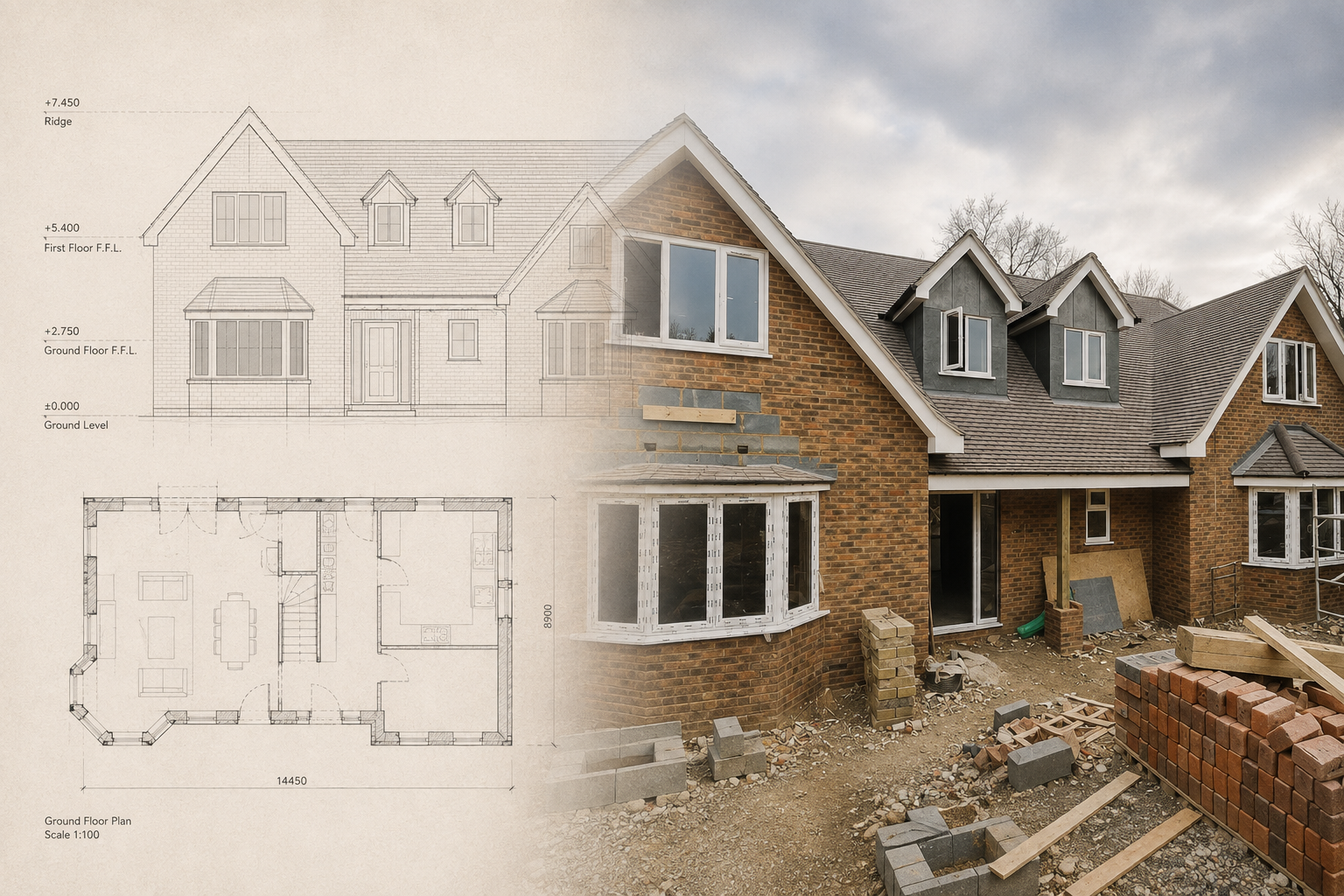
A detailed quotation is only genuinely useful when it can be reconciled with the information that was issued to the contractor.
If the construction drawings specify a particular structural arrangement, insulation performance, roof build-up, glazing specification or material, the quotation should be considered against those requirements. Otherwise, two contractors can appear to be pricing the same project while actually pricing different standards of construction.
This is another reason why good construction drawings matter so much.
A contractor cannot accurately price information that has not been provided. If the tender package is ambiguous, every contractor has to make assumptions, and they will not necessarily make the same assumptions.
The quality of the tender comparison therefore starts before the tender is even issued. The clearer the architectural drawings, structural information and specification, the greater the chance that the contractors will actually be pricing the same thing.
A Detailed Quote Still Does Not Guarantee a Successful Project
There is another important point here, because it is possible to become too focused on the document itself.
A quotation can look fantastic. It can be beautifully organised, professionally presented and broken down into extraordinary detail. That does not necessarily tell you whether the contractor is capable of delivering the project for the amount they have quoted.
Residential construction involves enormous amounts of coordination. Materials have to arrive at the correct time. Different trades have to follow one another. Structural work has to coordinate with architectural details and building services. Problems have to be identified and resolved. Variations need to be communicated and priced. Payments need to be managed and the client needs to understand what is happening throughout the process.
The contractor is therefore just as important as the quotation.
Be Careful With a Price That Looks Too Good
A very low tender is understandably attractive, particularly if the project has already stretched the client’s budget.
It should also prompt questions.
There may be a perfectly legitimate reason for the difference. Perhaps that contractor has lower overheads. Perhaps they have their own directly employed trades. Perhaps they have excellent supplier relationships or simply want the project because it fits perfectly into their programme.
Alternatively, something may have been missed.
A contractor who underprices a substantial project has a problem once construction begins. The labour still has to be paid, the materials still have to be purchased and the building still has to be completed.
That is why I would be cautious about choosing a contractor solely because their tender is substantially below everybody else’s. The objective is not necessarily to select the lowest number. It is to select a realistic commercial proposal from a contractor who appears capable of delivering what has been priced.
Make Sure the Agreement Becomes a Proper Contract
Once a preferred contractor has been identified, the quotation should not simply disappear into an email chain while everybody starts building.
For substantial residential work, there should be a suitable written contract clearly identifying the parties, scope of work, contract sum or pricing mechanism, payment arrangements, programme and procedures for dealing with changes and other relevant matters.
Variations are particularly important. Clients change their minds and buildings reveal unexpected conditions. Both are normal parts of construction, but they need to be managed properly.
If the client asks for something additional, the cost and programme implications should ideally be established before the work proceeds wherever practicable. Similarly, if the contractor discovers something genuinely outside the original scope, that needs to be communicated rather than simply appearing as an unexplained additional figure towards the end of the project.
Good documentation is not about preparing for an argument. It is about reducing the number of things there are to argue about.
Check the Contractor, Not Just Their Numbers
Perhaps the most important part of tendering happens away from the spreadsheet altogether.
Before appointing somebody to undertake a substantial residential project, I think clients should make a serious effort to investigate their previous work. Ideally, I would want to see examples of recently completed projects that are reasonably comparable to the proposed work and, where possible and with the previous client’s permission, speak directly to the homeowners who commissioned them.
Seeing the finished building is useful, but speaking to the person who paid for it is arguably even more valuable.
The questions I would ask are relatively straightforward. Did the project broadly go according to plan? Was the original quotation realistic? Did the final cost increase significantly, and if it did, why? Were additional costs discussed before the work was undertaken? Did the contractor communicate properly? Did trades turn up when expected? Were materials ordered at the right time? How were mistakes dealt with? Did the programme overrun substantially? Were there disagreements about money? Were defects dealt with afterwards? Most importantly, knowing everything they know now, would the client employ the same contractor again?
Those answers tell you things that a quotation cannot.
Try to Speak to More Than One Previous Client
If possible, I would want to speak to at least two previous clients.
There are legitimate reasons why a contractor cannot simply take prospective customers into somebody else’s home, so an inability to arrange a site visit should not automatically be treated as evidence of a problem. Privacy matters and previous clients have no obligation to entertain future customers.
However, if a contractor regularly undertakes substantial residential work but cannot provide any recent customers willing to recommend them or discuss their experience, I would want to understand why.
Photographs are not enough on their own. A portfolio tells you what the finished kitchen or extension looked like. It does not tell you whether the £150,000 quotation became £220,000, whether the project finished six months late or whether the homeowner and contractor were barely speaking to one another by completion.
What you really want to establish is whether there is a pattern of satisfied customers behind the finished photographs.
Two genuinely positive conversations with previous clients who have completed similar projects can provide a considerable amount of reassurance. It still cannot guarantee that another project will go perfectly, but it gives the homeowner much better information than simply choosing between three numbers on three pieces of paper.
The Highest Quote Is Not Automatically the Best Either
All of this does not mean that clients should simply choose the most expensive contractor.
A high quotation can be expensive because it is comprehensive and realistic, but it can also simply be expensive. Tender analysis works in both directions.
If one contractor is significantly higher than the others, they should also be asked why. Perhaps they have identified a genuine risk everybody else has missed. Perhaps their programme requires different resources. Perhaps their specification is higher. Perhaps they are extremely busy and the price reflects the commercial value at which they are prepared to take the project on.
The purpose of tender analysis is therefore not to prove that the cheapest contractor is wrong or that the most expensive contractor is safest. It is to understand why the prices are different.
Once those differences are understood, the client can make a much more informed decision.
Construction Is a Major Financial Commitment
For most homeowners, substantial building work will represent one of the largest financial commitments they ever make after purchasing the property itself.
We are sometimes strangely casual about that fact.
People will spend weeks comparing relatively inexpensive purchases, yet can find themselves selecting a contractor for a £150,000 or £250,000 building project after looking at a quotation, checking a website and having a couple of conversations.
The consequences of getting that decision wrong can be enormous. A dispute during construction can affect finances, living arrangements, family life, borrowing and the building itself. Contractor insolvency or abandonment can leave a client trying to appoint another company halfway through somebody else’s work, potentially with incomplete records and uncertainty over what has already been constructed.
No tendering process can eliminate those risks completely, but proper due diligence can reduce them.
What I Would Want to Know Before Appointing a Builder
By the time a contractor is appointed, I would want the client and design team to understand what is being built, what has been included within the price, what has specifically been excluded, which figures remain provisional, whether VAT has been dealt with correctly, how variations will be handled and what payment structure is proposed. I would also want any significant differences between the preferred contractor’s quotation and the other tenders to have been investigated rather than simply ignored.
Just as importantly, I would want some confidence in the company behind the number. I would want to know what they have built recently, whether previous customers were satisfied, how their projects performed financially and how the contractor behaved when things did not go perfectly, because construction projects rarely proceed without any surprises whatsoever.
That combination of commercial analysis and human due diligence is, in my view, far more useful than simply looking for the lowest tender.
What Are You Actually Paying For?
Ultimately, deciphering a builder’s quote is about understanding what sits behind the headline figure.
You are paying for bricks, concrete, timber, steel, insulation, windows, plumbing and electrical work, but you are also paying for labour, organisation, management, procurement, experience, overhead, risk and profit. You are paying somebody to take a set of drawings and turn them into a physical building while coordinating dozens of decisions and trades along the way.
That is why two contractors can look at exactly the same drawings and legitimately arrive at different prices.
The important thing is to understand those differences before signing the contract rather than discovering them during construction.
A good tendering process should leave the homeowner with more than the knowledge that Builder A costs £140,000 and Builder B costs £165,000. It should allow them to understand what each contractor is proposing to deliver, what remains uncertain, where the financial risks sit and why one proposal may represent better value than another.
Once that information has been established, the final decision becomes much more sensible. It is no longer simply a question of which builder has produced the lowest number. It becomes a decision about which contractor has produced a realistic price for the project you actually want to build and has given you enough evidence to trust them with delivering it.
That is a much better basis on which to hand somebody one of the largest sums of money you are ever likely to spend.
Further Reading and References
HM Revenue & Customs’ guidance on VAT for builders is particularly useful when comparing residential quotations because VAT treatment can materially alter the headline price. Most work carried out by builders and similar trades to existing houses and flats is subject to the standard 20% rate, although qualifying new dwellings, certain conversions, renovations and other specific circumstances can be treated differently.
HMRC — VAT for builders: houses and flats
HMRC — Buildings and construction, VAT Notice 708
The precise commercial and contractual treatment of allowances, variations, payments, contractor mark-ups and other items will depend upon the tender documentation and building contract being used. For significant projects, clients should consider appropriate professional advice rather than assuming that a contractor’s quotation alone deals with every contractual issue.